A member asked us this week, in so many words: and what's supposed to be different here from the big apps? Or better — safer?
Fair question. "Safer" gets thrown around a lot, usually right next to a verified badge and a feel-good paragraph. So here's the actual answer, as concretely as we can give it: four decisions we made while building DudesChat, what each one does for you, and why we made it. One of them is about a part of the world most apps quietly ignore.
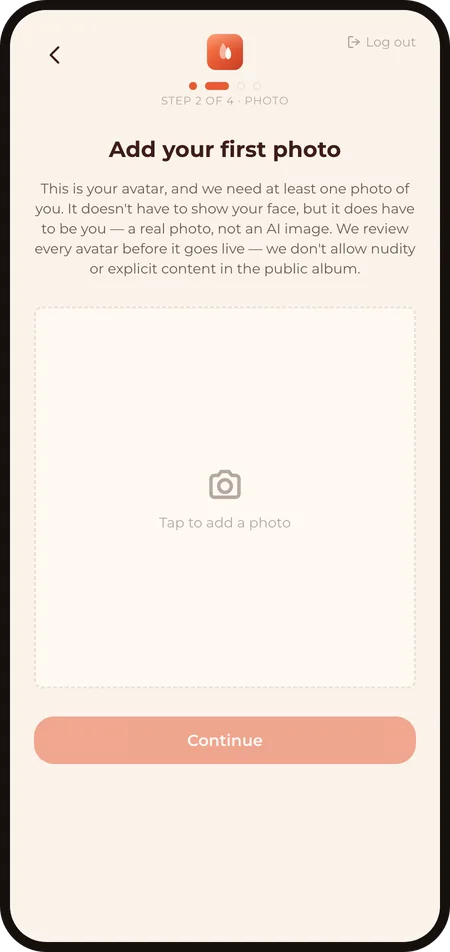
1. Faces are optional. A face you see is real.
Open most apps and you'll be nudged, prodded and eventually ranked down until you put your face on your profile. The logic sounds reasonable: faces build trust, faces reduce fakes. We agree with the goal. We refuse the method, and the reason is a map.
Where a face photo is a risk for everyone
In more than 60 countries, being gay is still a crime. In many more it's legal on paper and dangerous in practice: a screenshot of your face in a gay app, passed to the wrong colleague, relative or landlord, ends a job, a marriage, a tenancy — sometimes worse. In a number of places, police and criminal gangs actively work gay apps to identify and entrap men. There, a face photo isn't a trust signal. It's evidence.
We won't list those countries here; the members who live in them know exactly which ones they are. What matters is this: a rule that is a mild annoyance in Zurich or Berlin becomes a genuine danger elsewhere. An app that forces a public face photo has made a choice, whether it admits it or not: either members in those regions can't use it at all, or they comply and expose themselves to do so.
We build for the whole community, not just the parts of it that live in safe places. So on DudesChat, nobody is ever required to show their face publicly. There's no ranking penalty, no "add a face to get more matches" nag, no badge you're missing. A profile without a face is a choice here, not a red flag. And the ways to show your face selectively — your private album, a live photo in a one-to-one chat — are built in, so the decision of who gets to see you stays exactly where it belongs: with you.
Why the face you do see can be trusted
Optional doesn't mean unverified. Every member passes a live check before they can fully join: a real person, live on camera. Nobody gets in on a borrowed picture. On top of that, your profile photo has to be an actual photograph of you — AI images don't qualify — and every public photo is reviewed by a person before it goes live.
So the deal is simple. Showing your face is your call. But when a profile does show one, it matches the person behind it. You never have to wonder whether the Dude in the picture exists. He does, and he's the one typing.
2. In a one-to-one chat, photos and videos are live. Not uploaded.
Here's where a lot of the damage on other apps actually happens: the chat. On most apps, sending a photo means picking any file from your phone. That's how you end up with pictures that are ten years old, pictures of someone else, pictures pulled from the internet, pictures generated by a machine — and the unsolicited dumps nobody asked for.
On DudesChat, you can't upload photos or videos from your gallery into a one-to-one chat. Media in a chat is taken live, with the camera, right in that moment.
What that means in practice: whatever you receive, the Dude you're talking to just recorded himself, seconds ago. Not saved, not forwarded, not downloaded. If he says he's at the lake, the photo was taken at the lake. If he shows you his face, it's his face, today.
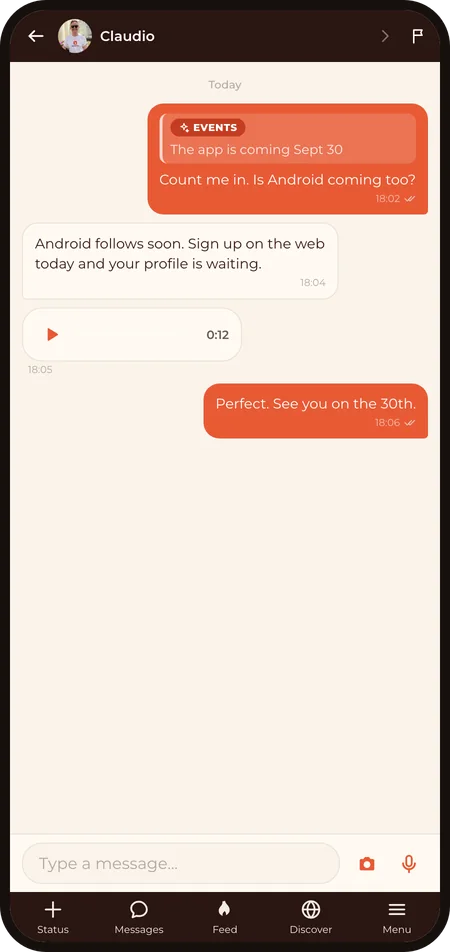
And the same protection runs the other way — what you share in a chat was taken for that chat, not fished out of a folder of things that have already been sent to twenty people.
This is also where the first decision pays off. A member who keeps his face off his public profile for safety isn't stuck being faceless forever. In a one-to-one chat he can show exactly one person, exactly when he decides to — live, and gone from the public eye the moment the conversation is.
3. Blocking never takes away your right to report
On many apps, blocking someone makes them vanish — from your inbox, from your view, and, inconveniently, from your ability to report them. The conversation is gone, the profile is gone, and with it the evidence. So you're left with a bad choice in the worst possible moment: cut the contact now, or keep it open long enough to file a report. Under threat, people choose safety. The report never happens, and the next Dude meets the same person.
We separated the two. On DudesChat, blocking ends the contact immediately — he's out of your way, that instant. And for the next 7 days, the option to report him stays open, with the conversation preserved so that a real person on our team can see what actually happened.
Safety first, accountability second, both guaranteed. In a situation that's turning threatening, that order matters: you don't have to be brave and thorough at the same time. Get him out, breathe, then report when you're ready.
This one came out of research. In its 2025 NiceAF project, the public-health nonprofit Building Healthy Online Communities (BHOC) asked app users what would reduce harm after a bad encounter, and most wanted to be able to report someone even after he had blocked them or deleted his account. BHOC suggested it to its app partners; we built it in. On 27 October 2026 BHOC featured it: "DudesChat + BHOC launch new safety features".
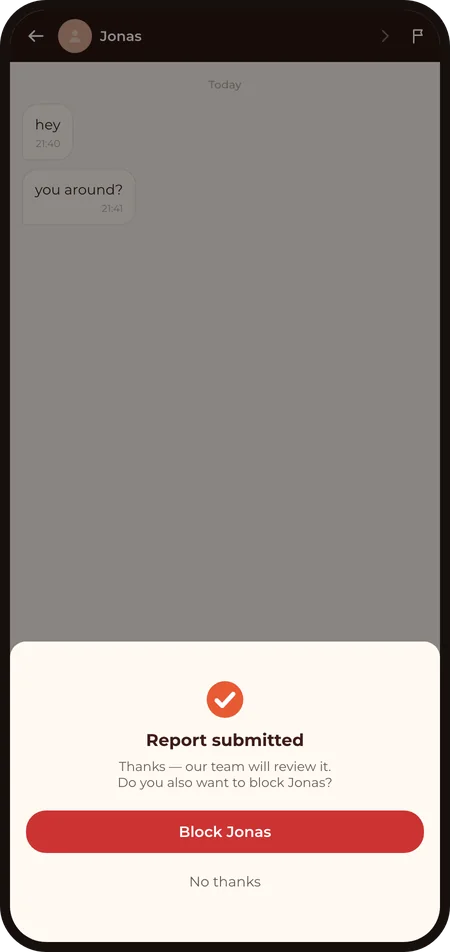
(And if he deletes his profile to disappear? You can still report him then, too — your chat stays, and serious reports go to a specially trained reviewer. We wrote about that one separately.)
4. Where you are is an area. Never a pin.
The oldest trick against gay men on apps is also the simplest: distance. Security researchers showed years ago that an app which tells you "he's 340 metres away" will, from three different spots, tell you exactly where he is. Three circles, one crossing point: a street, a building, a door. It's called triangulation, and in some of the countries from section one it hasn't stayed a research paper.
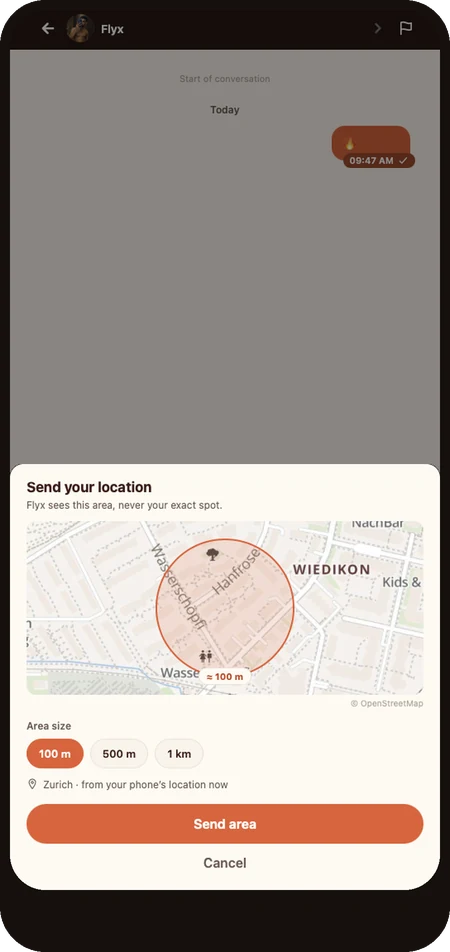
So DudesChat never hands out a position you could triangulate from. In Discover, your location is rounded to a coarse grid before it's used anywhere, and others see a rounded distance — never coordinates, never a pin.
And when you want to share where you are, you share an area, not a spot. In a one-to-one chat, Send your location puts a circle on the map, and you pick its size: 100 m, 500 m or 1 km. He sees the circle, nothing finer. In a dense city, 100 m is a few blocks and dozens of buildings. In a village, 100 m can be a single house — so there you widen the circle to 500 m or 1 km, and rural members get the same protection as anyone downtown. You decide how much to give away, every single time.
Why we built it this way
None of these four is a feature we bolted on to look responsible. They come from the same place: we know who our members are, and we know that for a good part of them, the stakes of being seen are not the same as for a Dude in a Western European city centre. An app that ignores that isn't safer. It's just safer for some.
Let's be honest about the limits, too. No app makes meeting a stranger risk-free, and we're not going to pretend otherwise. What we can do is make sure the face you see is real, the photo you get is from now, the moment you need to protect yourself never costs you the chance to be heard — and where you are stays an area, never a pin.
That's the difference. Not a badge — a set of decisions, made with the whole map in front of us.