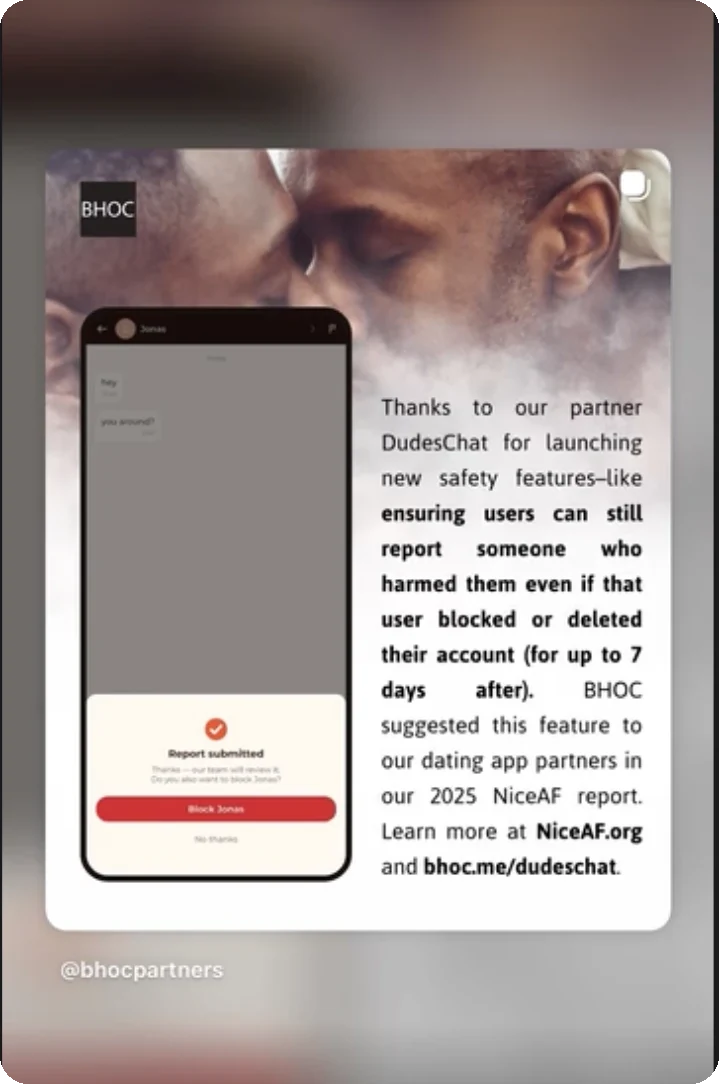
On 27 October, Building Healthy Online Communities (BHOC) highlighted a DudesChat feature: you can still report someone who harmed you for up to seven days after they block you or delete their account.
BHOC also explained where the idea came from. In its 2025 NiceAF research, it asked app users what would reduce harm in bad situations. Most wanted to report harmful behaviour, and many had hit a wall at exactly that point: the other person had blocked them, or had simply disappeared.
That path, from what people went through, to a community-health organisation's recommendation, to a change in the product, deserves a closer look. It raises a question bigger than one feature or one app: whose interests do the everyday decisions inside an app serve?
I run DudesNude and DudesChat. Our partnership with BHOC keeps that question in front of us, and their announcement is a good moment to explain the decisions behind this feature and the responsibilities that come with it.
Blocked before you could report
I know the problem first-hand. On another app, someone insulted me and blocked me before I could report it. The profile was gone, and so was the conversation. The person who sent the insult had ended the contact, and as far as I could tell, they had also decided whether anything would ever be done about it.
Blocking is an essential protection. You must be able to stop unwanted contact at once. But ending contact and reporting what already happened are two different needs, and you should be able to do both, without keeping a threatening conversation open while you work out how to document it.
The same gap opens when the person responsible blocks first. The recipient loses the profile, the conversation and the obvious route to a report, all through a decision made by the very person they want to report.
Why a support form is not enough
A support form elsewhere does not really solve this. Grindr, for example, documents that a blocked profile no longer sees the person who blocked it, in the app or in the inbox, and its support form does accept reports from people who were blocked. So a route exists. But you have to find it, and then describe an exchange you can no longer see.
For someone who has just been abused, the difference between that and a report button next to the conversation is substantial. Finding the right help page, naming an account that has vanished and reconstructing what was said all become extra work. Screenshots help, but nobody should have to expect mistreatment and save every conversation in case they need evidence later.
What a block does on DudesChat
This is the gap the feature closes. When a block happens on DudesChat, access to the full profile ends: photos and profile details disappear. What stays, for seven days, is what a report needs: the username, the status in question and the one-to-one conversation. The same applies for seven days after someone deletes their account.
Nobody gains new access to anyone. You keep the context of a conversation you were already part of.

Three decisions that most apps bundle into one stay separate here:
- whether someone can contact you,
- whether they can see your profile,
- whether you can report something that already happened.
Keeping a conversation comes with obligations
Privacy matters in all three. Keeping a conversation reportable brings duties with it: a defined retention period, restricted access, and a clear explanation of how the information is used. It never justifies keeping everything forever, or making private conversations routinely available to staff. But removing someone's access to a profile does not require removing the ability to report what they did.
When the stakes are higher
Sometimes the stakes go far beyond an abusive message. In July, Berlin police and prosecutors reported an arrest after a series of robberies in which men were lured to meetings through fake profiles on dating apps, as the prosecutors put it. Cases like that make usable reports and careful evidence preservation concrete. They do not prove that any one feature would have prevented those crimes.
A platform's responsibility is to make it possible to raise a concern, identify the account involved and examine the available context. Where records are kept, they can also support a lawful investigation, with careful assessment and protection of sensitive information.
The report is only the beginning
Someone has to assess what arrives through the report button. On our platforms, reports go to administrators, and every report is reviewed by a person within 24 hours. The response depends on the conduct and on the published rules: a warning, a temporary restriction or a longer ban. Serious harm needs an urgent response; it should not have to pass through a series of minor warnings first.
Review also needs memory. When a new report connects to an earlier concern, that context matters. Otherwise repeated behaviour is treated as a string of unrelated incidents.
The responsibility runs both ways. Administrators hold power over members, and human review can still get things wrong. Explanations, proportionate decisions and a way to challenge them are part of a healthy community too.
Clarity is part of it. Being blocked, finding a deleted account and discovering that someone has been suspended can otherwise look the same, and a member may read an enforcement action as one more unexplained rejection. Nobody needs the confidential details of an investigation or the name of whoever reported an account. But everyone needs enough information to understand what the platform is telling them and what they can still do.
A practical standard
BHOC's announcement matters because it brings the discussion back to what people asked for. They described a specific obstacle to reporting harm, and the answer required a change in how the product behaves at the moment a connection ends.
That is a practical standard for community-minded design: listen to the difficulty people run into, look at who carries its consequences, put the remedy where it is needed, then provide the human follow-through that makes it useful.
The seven-day window is one way to meet that standard. It is not a complete answer to safety, and its value depends on what happens when someone uses it.
A block should give you control over future contact. It should also leave you a clear way to ask the platform to look at what already happened. What a platform allows at that moment says a great deal about whom it is designed to protect.
Thank you to Jen and the BHOC team for the research, the feedback on our health section and the shout-out. Follow them on Instagram: @bhocpartners.
The other things that make DudesChat safer: Optional, but real →